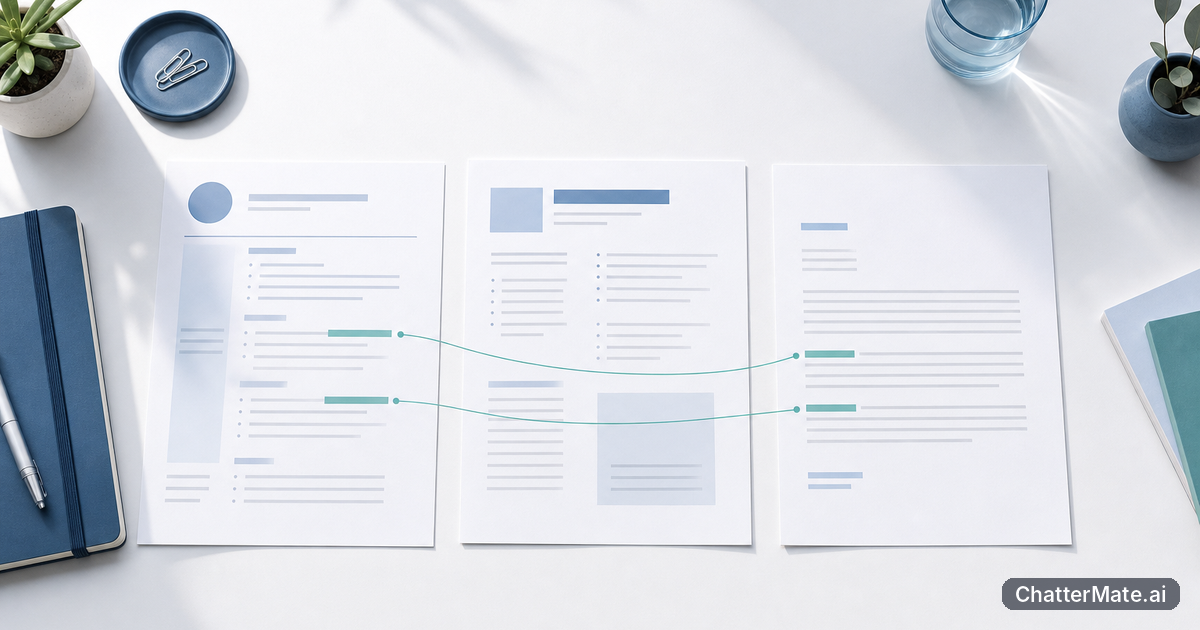
A résumé can show what you did, yet still leave an employer wondering why you want this particular role. AI can help you turn those facts into a focused cover letter, but it works best when you bring the direction and proof. Start with one job, choose a true example that matches its needs, and use AI to organize your first draft—not to invent a more impressive version of you.
Struggling to Make Your Resume Feel Personal? Start Your Cover Letter With a Clear Story
Your résumé is built for scanning: titles, dates, skills, and outcomes. A cover letter gives you room to connect those facts to one employer’s needs. Before you ask AI to write anything, answer three questions: What does this job need? Which experience proves you can do it? Why does this role make sense as your next step? Those answers give the letter a personal center.
For example, if a job asks for someone who can improve customer onboarding, don’t begin with “I am a results-driven professional.” Recall a real moment: you noticed new customers were repeating the same setup questions, created a clearer guide, and helped reduce confusion. Use only details you can stand behind. That small story makes your résumé’s experience relevant instead of simply repeating it. A useful cover letter also sounds like a person speaking plainly, not a list of skills dressed up as a paragraph.
Turn Your Resume Into a Tailored AI Cover Letter With Specific Examples
Give the AI tool the job description, the relevant résumé details, and your answers to those three questions. Then set clear boundaries: ask for a concise draft that connects one or two requirements to real examples, keeps your tone straightforward, and leaves any missing information as a question rather than guessing. You can improve the result by following practical prompting guidance for better AI answers.
Say, for instance, “The role asks for cross-team coordination. Use my example of organizing weekly launch updates across design and support. Don’t claim I led the whole launch; I coordinated updates.” That instruction gives the draft a specific, credible point. You might also ask for an opening that explains your interest in the employer, then a paragraph built around the example, followed by a short close. Treat the output as raw material: keep the useful structure, replace language that feels inflated, and add a detail only you know.
Check the Draft for Generic Claims, Errors, and a Voice That Doesn’t Sound Like You
AI can make a letter sound polished while smoothing away the details that make it believable. Read each sentence and ask: Could this line describe thousands of applicants? If so, replace it with evidence. “I’m an excellent communicator” is hard to assess; “I wrote a weekly status note that helped sales and operations catch delivery changes earlier” gives the reader something concrete to understand. Keep the claim proportional to what you actually did.
Next, compare the draft against your résumé and the job listing. Check every title, date, tool, result, and company name. If the AI says you managed a team but you only coordinated work across peers, correct it. Read the letter aloud, too. Would you use phrases such as “uniquely positioned” in a conversation? If not, simplify them. For a useful way to think about AI as a drafting partner rather than an authority, see this guide to working with AI creatively. Your final check should be whether the letter sounds like you and makes a truthful case for this role.
Choose One Job and Write a Better First Draft Today
Pick a live job posting, not a generic role you might apply for someday. Highlight one requirement you can support with a real example, then write that example in plain language: what was happening, what you did, and what changed. Gather the matching résumé details and ask AI for a draft that uses only that information. If a sentence needs a fact you haven’t supplied, tell the tool to flag the gap rather than filling it in.
Set a short limit for the first pass: one opening, one evidence paragraph, and a brief close. Then edit for accuracy, relevance, and your own voice. You don’t need to automate the whole application. The goal is a clearer starting point that saves time without taking your judgment out of the process. Before sending, read the letter beside the posting once more and remove anything that doesn’t help explain why your experience fits this particular job.
Frequently asked questions
Enjoyed this read?
Like, Share or comment below.