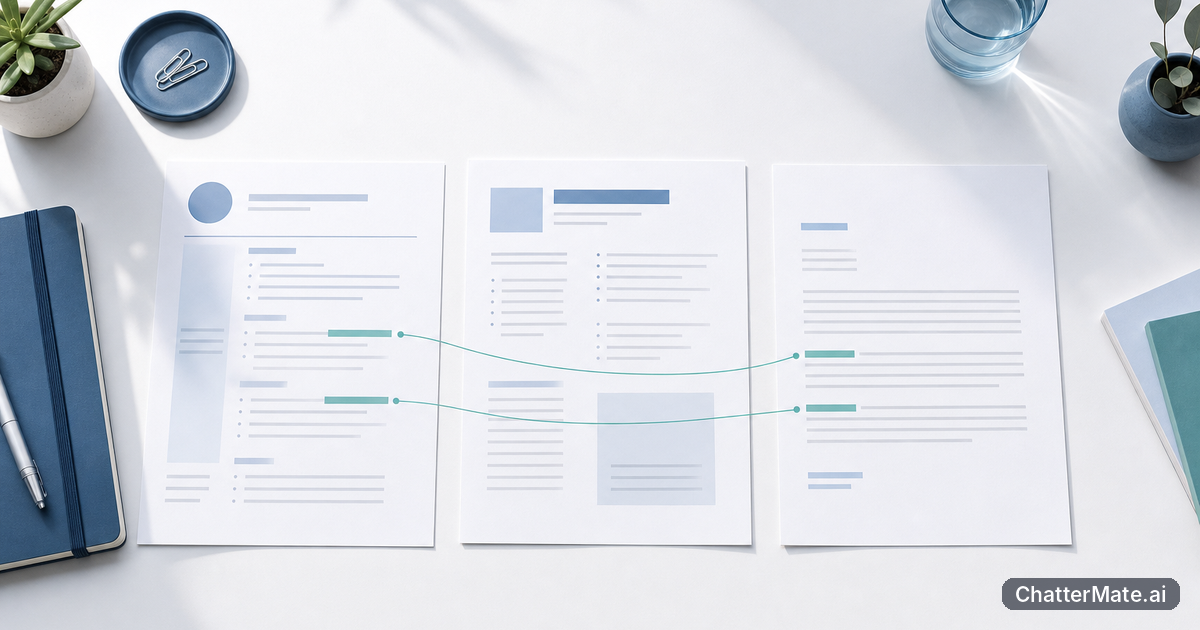
You already have a current resume and a specific job posting; the hard part is making them speak to each other. A useful cover letter does not retell your work history. It chooses a few relevant accomplishments, explains why they matter to this employer, and makes it easy to picture you in the role. Here’s a practical way to draft one without starting from scratch.
Find Employer Priorities to Highlight in Your Job Search Cover Letters
Read the posting once for the role, then again with a highlighter—or a short notes list—for repeated needs. Look for responsibilities, required skills, and outcomes the employer emphasizes. If the posting says the person will improve onboarding, coordinate across teams, and measure retention, those are stronger clues than a generic request for someone who is “results-oriented.” Choose two or three priorities you can support with real experience. Keep the resume and posting close as your source material: if you use ChatterMate’s Knowledge Base & RAG, you can upload your resume and add the job-posting URL, then ask questions grounded in those materials. Retrieved answers can include citations, which help you check where a detail came from. For more on using documents and URLs as grounded context, see this guide to cited knowledge-base answers.
Turn the priorities into a simple brief: “They need X; I can show Y.” That keeps the letter aimed at this role instead of becoming a general introduction.
Choose two or three accomplishments, not your whole history
Scan your resume for evidence that answers the brief. A useful accomplishment has an action, a specific contribution, and—when you have it—a result. For an onboarding-focused role, a bullet such as “Rebuilt new-hire checklist; partnered with four team leads; cut average ramp time from six weeks to four” is more useful than “Responsible for onboarding.” Pick examples that demonstrate different strengths rather than repeating the same one three times. You might use one accomplishment for process improvement and another for collaboration. Keep the evidence accurate: do not turn “supported a project” into “led a project,” or add a number you cannot verify. If you ask ChatterMate to help map your materials to the posting, mention the relevant resume and job description in the conversation so those sources provide context. Treat suggestions as a starting point, not proof; check each claim against your resume.
Tip: Keep a small “evidence bank” of two or three resume bullets beside the posting. Your letter should explain why that evidence matters, not repeat the bullets verbatim.
Turn resume bullets into a tailored opening and body
Here’s a before-and-after. Resume bullet: “Created onboarding checklist with four team leads; reduced average ramp time from six weeks to four.” A tailored paragraph could say: “Your posting highlights a smoother onboarding experience across teams. In my current role, I worked with four team leads to rebuild our new-hire checklist, helping reduce average ramp time from six weeks to four. I’d bring that same practical, collaborative approach to improving onboarding at your organization.” The facts stay the same, but the paragraph connects the accomplishment to a stated need and explains its relevance. Open with a direct sentence naming the role and the priority that drew you to it, then use one or two short paragraphs to make these connections. You can use an @mention to bring the resume or job-posting context into a ChatterMate conversation, but verify retrieved details against the original source. For another perspective on drafting more efficiently, see this practical guide to drafting faster.
Avoid claims that are not supported by your experience, and don’t paste citations into the finished letter. They are useful for checking sources; the employer-facing prose should read naturally.
Close directly, then check the letter against your sources
End with a brief, confident invitation to talk. For example: “I’d welcome the chance to discuss how my onboarding experience could support your team. Thank you for your consideration.” This gives the reader a clear next step without overexplaining or claiming you are the perfect candidate. Before sending, check the role title and employer name, and make sure each body paragraph connects a specific accomplishment to a priority in the posting. Confirm every metric, date, and responsibility against your resume or another reliable source. Remove any sentence that simply repeats a resume bullet without adding context. Finally, read the letter aloud: it should sound like a person explaining a relevant example, not a list of keywords. Save a copy of the job posting with your draft so you can confirm the details if the listing changes. If the letter still feels generic, return to the posting and replace a broad claim with one concrete need and one piece of evidence.
Your next step is simple: choose one application, write down its top priorities, and build a short letter around your strongest two or three examples.
Related reading
Frequently asked questions
Explore ChatterMate
Enjoyed this read?
Like, Share or comment below.