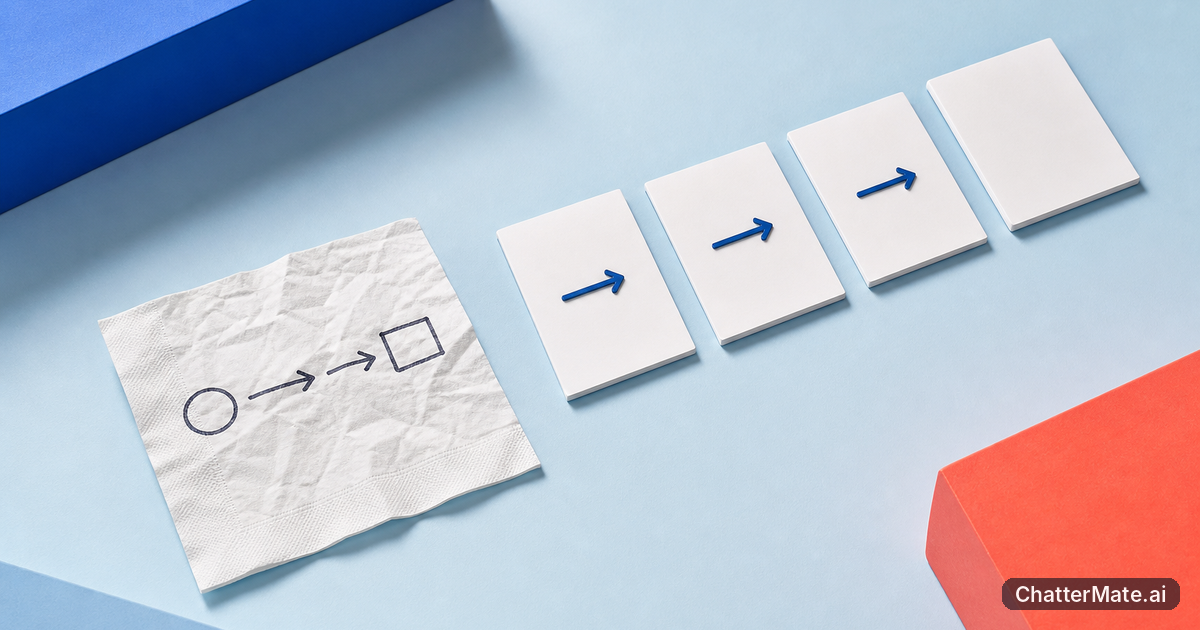
You have a good idea on a napkin, but turning it into a deck means deciding what the sketch really says, what belongs on each slide, and how to make it clear to others. A simple workflow can help you move from napkin sketch to slide without losing the spark that made the idea worth sharing.
Capture ideas during creative brainstorming before polishing them
Start with the sketch itself, not a request for a finished presentation. Write down what each shape, arrow, and note means in plain language. For example: “The circle is our customer; the three arrows are steps in their onboarding; the final box is the moment they see value.” Add the audience, the purpose of the deck, and any constraints, such as a five-slide limit or a launch meeting next week.
This small translation step keeps the first draft grounded in your thinking rather than in assumptions. If teammates contributed to the drawing, ask what they intended before interpreting it for them. You can also list open questions beside the description: Is the middle step a product feature or a customer action? Does the last box represent a result or a recommendation? Those questions become useful prompts for the next stage.
Tip: Keep a photo of the sketch beside your written description. It gives your team a quick reference when an AI-generated outline starts to drift.
Use model comparison to explore directions
Once the idea is described, ask for a few different ways to structure it. One prompt might request a concise five-slide narrative for a marketing team; another can ask for a story-led version or a version that starts with the customer problem. Compare the outlines for useful differences, not just polished phrasing. Does one make the cause-and-effect clearer? Does another surface a risk your team had not discussed?
With ChatterMate’s Multi-Model Chat, you can compare responses from OpenAI, Claude, Gemini, and Grok side by side. Give each model the same sketch description and audience so the comparison is meaningful. Then choose the strongest ideas and edit them together; the goal is not to accept a model’s outline unchanged. For a related way to evaluate options, see how to compare, choose, and build with multi-model chat.
Shape the strongest outline into slides
Before you focus on visuals, give every slide one job. A practical sequence for the onboarding example could be: introduce the customer’s starting point, show the friction they face, explain the three onboarding steps, describe the value moment, and finish with the decision or next action. If two slides make the same point, combine them. If a slide needs a long explanation, consider whether it is doing too much.
Now add a headline and a few supporting details to each slide. Use concrete language: “New users miss the setup step” is easier to act on than “Onboarding needs improvement.” ChatterMate’s Canvas Pro supports slide artifacts alongside chat, so you can develop the chosen direction in a visual workspace. If you want another practical perspective on turning an idea into a deck, read how to turn a single prompt into a deck.
Review the deck as a team, then take one next step
Share the draft with someone who did not help make the sketch. Ask them to explain the story back to you using only the slide headlines. If they cannot describe the problem, the proposed change, and the result, the sequence may need work. A marketer might also check that claims are supported and that the audience is clear; a designer can flag slides that rely on too many competing ideas.
Make revisions against the original sketch description, not against a vague feeling that the deck should look more polished. When the story holds together, decide what the team needs next: feedback from a stakeholder, real customer evidence, or a visual pass. To begin, photograph one sketch, write a short description of its shapes and intended outcome, and ask your team to compare two possible slide outlines. That gives you a concrete first draft to discuss.
Frequently asked questions
Explore ChatterMate
Enjoyed this read?
Like, Share or comment below.